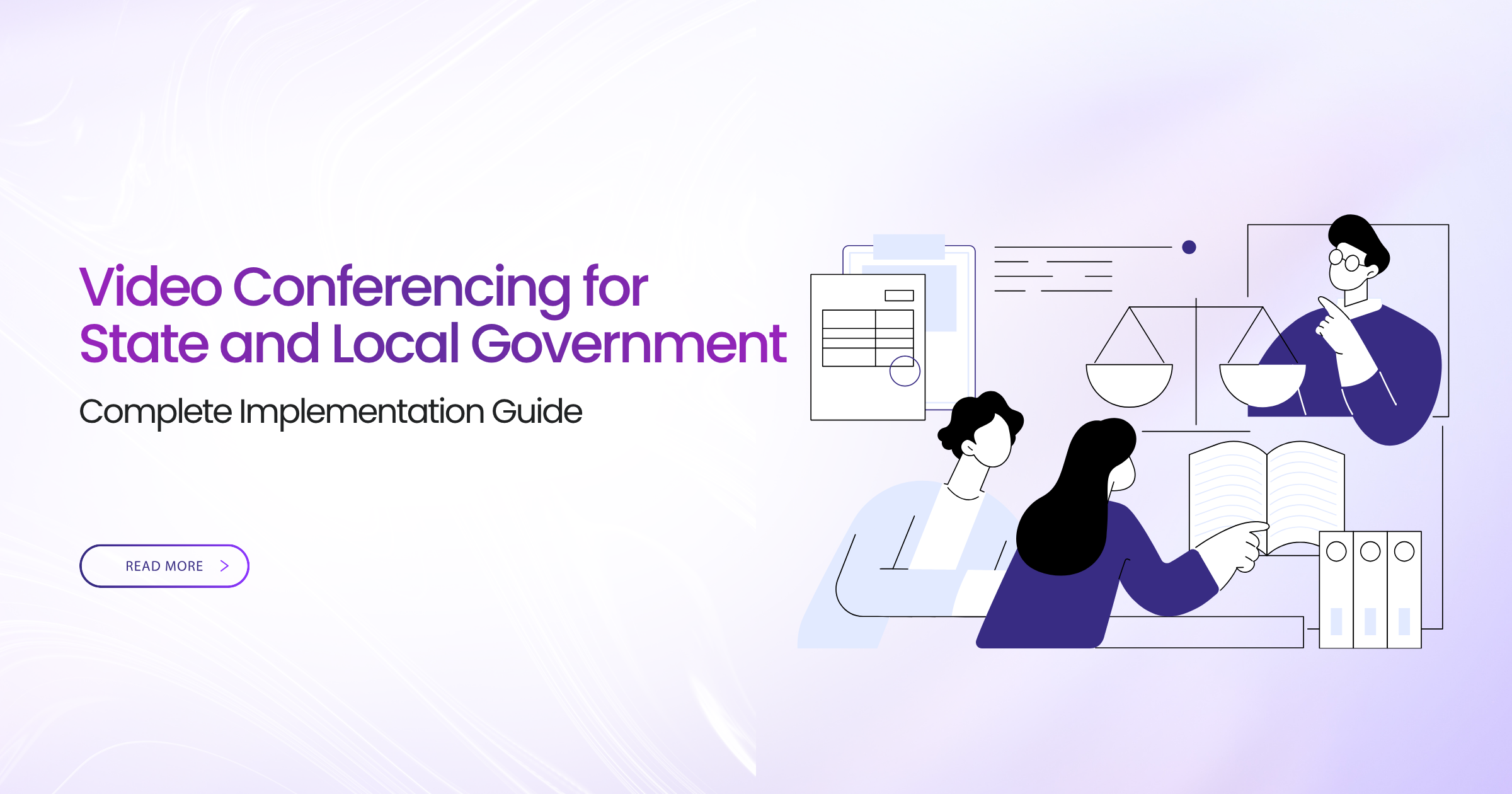
Meta Title: Video Conferencing for State and Local Government | Complete Guide
Meta Description: Complete guide to video conferencing for state and local government. Learn legislative sessions, public hearings, emergency management, StateRAMP compliance, funding sources, and implementation strategies.
Target Keyword: state local government video conferencing
Word Count: ~3,000 words
Reading Time: 14 minutes
Introduction
The City Manager of a mid-sized municipality faced a crisis that exposed her city’s video conferencing inadequacy. “We needed to conduct a city council meeting during a snowstorm,” she told me. “Half our council couldn’t reach city hall safely. We tried using a free consumer platform for remote participation.”
“The meeting was a disaster. Audio cut in and out. Video froze. Public comments were garbled. Residents watching from home couldn’t understand proceedings. The local newspaper ran a scathing editorial about government incompetence and lack of transparency.”
“Worse, our city attorney later informed us the meeting might not have been legally valid—our open meetings law requires ‘reasonable access’ to proceedings. Terrible audio and video doesn’t meet that standard. We might have to redo votes on three ordinances.”
The failed meeting cost the city directly:
$15,000 in legal review
$8,000 to re-notice and re-conduct votes
Incalculable damage to public trust
Council productivity lost for weeks
“We realized video conferencing isn’t ‘nice to have’ for modern government—it’s essential infrastructure. But we need something designed for government, not adapted from consumer or corporate tools.”
This scenario plays out constantly across state and local governments. Cities, counties, states, and special districts need video conferencing for legislative sessions, public hearings, constituent services, emergency management, and inter-jurisdictional collaboration. But they face unique challenges: public access requirements, open meetings laws, limited budgets, diverse technical capabilities, and scrutiny from constituents and media.
This guide provides state and local governments with comprehensive understanding of video conferencing requirements and implementation strategies. You’ll learn how to meet open meetings requirements, enable public participation, manage emergency communications, achieve compliance, secure funding, and implement successfully despite budget constraints.
Whether you’re a city, county, state agency, or regional authority—this guide helps you implement video conferencing that serves government operations and constituent needs.
Let’s start with understanding what makes state and local government unique.
State and Local Government Needs
State and local governments have distinct video conferencing requirements that differ from both federal agencies and private organizations.
Key Differentiators
Public Access Requirements
Unlike federal agencies or corporations, state and local governments must provide public access to many proceedings.
Open meetings laws mandate:
- Public notification of meetings
- Public attendance (in-person or remote)
- Public comment opportunities
- Recording and archiving of proceedings
- Accessibility for persons with disabilities
Video conferencing must enable, not hinder, public access.
Budget Constraints
State and local budgets face intense scrutiny and limitations.
Financial realities:
- Taxpayer accountability for every expenditure
- Competing priorities (public safety, infrastructure, education)
- Revenue fluctuations with economic cycles
- Limited IT budgets and personnel
- Grant dependency for major technology investments
Solutions must deliver value within tight budgets.
Technical Diversity
Unlike federal agencies with standardized IT infrastructure, state and local governments have enormous technical diversity.
Wide range of capabilities:
- Some jurisdictions have sophisticated IT departments
- Others have single IT person or outsourced support
- Infrastructure ranges from modern to decades-old
- Staff technical proficiency varies widely
- Citizen access varies (high-speed internet to dial-up)
Solutions must work across technical capability spectrum.
Geographic Scale Variation
State and local governments range from small towns to major metropolitan areas.
| Government Type | Typical Size | Video Conferencing Needs |
|---|---|---|
| Small Municipality | 1,000-10,000 residents | Council meetings, citizen services, regional collaboration |
| Mid-Size City | 10,000-100,000 | All above plus: public hearings, department meetings, public safety coordination |
| Large City | 100,000-1M+ | All above plus: multiple simultaneous meetings, enterprise collaboration, 311 services |
| County | Varies widely | Board meetings, court proceedings, multi-site coordination, service delivery |
| State Agency | Varies | Legislative support, inter-agency coordination, constituent services, regional offices |
| Special District | Varies | Board meetings, service coordination, public engagement |
Solutions must scale from small to large deployments.
Common Use Cases
Legislative and Governance
City councils, county boards, state legislatures
Committee meetings
Public hearings and comment sessions
Work sessions and planning meetings
Constituent Services
Virtual office hours for elected officials
Permit applications and reviews
Social services appointments
311 inquiry handling
Virtual town halls
Inter-Jurisdictional Collaboration
Regional planning meetings
Mutual aid coordination
Shared services discussions
Joint task forces
Multi-agency initiatives
Emergency Management
Emergency Operations Center communications
Incident command coordination
Multi-agency response
Public safety briefings
Crisis communications to residents
Internal Operations
Department meetings
Training and professional development
Remote work enablement
Recruitment and interviews
Budget hearings
Legislative Sessions and Meetings
Legislative bodies (councils, boards, legislatures) have specific video conferencing requirements.
Open Meetings Law Compliance
Every state has open meetings laws (sunshine laws) governing public body proceedings.
Typical requirements:
Public Notice:
- Advance notice of meetings (24-72 hours typically)
- Notice must include how public can access meeting
- If virtual or hybrid, access information must be provided
Public Access:
- Members of public must be able to attend
- For virtual meetings, technical access must be provided
- Access must be “reasonable”—poor quality doesn’t satisfy requirement
Public Comment:
- Opportunity for public to comment must be provided
- Virtual meetings must enable remote public comment
- Comments must be audible to all participants
Recording and Minutes:
- Most states require recording of proceedings
- Recordings must be retained per state law
- Accessible to public upon request
Quorum and Voting:
- Some states require physical quorum
- Others allow virtual participation in quorum
- Voting procedures must be clear and auditable
- Roll call votes must be clearly recorded
Technical Requirements for Legislative Meetings
High-Quality Audio is Non-Negotiable
Legislative proceedings require crystal-clear audio for legal compliance and public understanding.
Audio requirements:
- Professional-grade microphones (not laptop/tablet mics)
- Acoustic treatment of meeting chambers
- Audio mixing for consistent levels
- Echo cancellation for hybrid meetings
- Recording quality suitable for archival
Video Quality Matters
While audio is primary, video quality affects transparency and accessibility.
Video requirements:
- HD resolution minimum (1080p preferred)
- Multiple camera angles (speaker, audience, visual aids)
- Automatic camera switching (follows speaker)
- Gallery view showing all participants
- Screen sharing for presentations and documents
Public Access Infrastructure
Enable robust public access without technical barriers.
Multi-Modal Access:
- Web-based viewing (no app required)
- Dial-in audio access (for low-bandwidth constituents)
- Cable TV broadcast (where available)
- YouTube or similar streaming (for broader reach)
- Mobile-friendly access
Public Comment Integration
Enable effective public comment in virtual/hybrid meetings.
Implementation approaches:
Registration System:
- Pre-registration to speak (online form)
- Queue management showing wait time
- Automatic notification when approaching turn
- Time limit enforcement (visual countdown)
Comment Channels:
- Live video comment (primary method)
- Phone dial-in comment (backup/accessibility)
- Written comment submission (for those unable to speak)
- Real-time moderation capabilities
Hybrid Meeting Configurations
Most legislative bodies use hybrid meetings—some participants in chamber, some remote.
Chamber Setup:
Council/Board Members:
- Fixed cameras and microphones at each seat
- Individual displays showing remote participants
- Voting buttons (if applicable)
- Document displays
Staff and Presenters:
- Dedicated stations for staff presentations
- Document camera for physical documents
- Wireless presentation capability
- Backup systems for critical presentations
Public Seating:
- Podium with camera and microphone for public comment
- Displays showing remote participants
- Overflow seating with video feed if capacity limited
Remote Participation:
Enable remote council members and public to participate fully.
Technical considerations:
- Equal audio quality for remote and in-person
- Background noise suppression for home participants
- Screen layouts showing both chamber and remote participants
- Visual cues for whose turn to speak
- Closed captioning for accessibility
Case Example: City Council Meeting
City of Riverside (hypothetical 50,000 population):
Meeting Format:
- 7 council members (typically all in chamber, occasionally remote)
- Mayor presiding
- City staff presentations
- 10-20 public comment speakers per meeting
- 100-200 citizens viewing remotely
Technical Setup:
In Chamber:
- PTZ cameras (3): dais, podium, audience
- Individual microphones at each council seat
- Podium microphone for public comment
- 75″ displays for remote participants
- Audio system integrated with video conferencing
Online:
- YouTube live stream for viewing
- Web portal for public comment registration
- Video conferencing link for registered speakers
- Dial-in number for audio-only access
- Closed captioning (automated + human refinement)
Workflow:
- Public pre-registers to comment (online form)
- System assigns queue position and estimated time
- Email notification 5 minutes before turn
- When called, speaker unmuted and video activated
- 3-minute timer visible to speaker and council
- Recording archived on city website
Cost: ~$75,000 for chamber equipment, $15,000 annual platform costs
Results:
- Public participation increased 40%
- Younger demographics engaged (previously absent)
- Meeting recordings viewed 5,000+ times annually
- Zero legal challenges to meeting validity
- Reduced travel burden on rural residents
City Council and Public Hearings
Public hearings have additional requirements beyond regular meetings.
Public Hearing Requirements
Enhanced Public Notice:
Hearings typically require more extensive notice than regular meetings.
Notice methods:
- Legal newspaper publication
- Website posting
- Social media announcements
- Direct notification to affected parties
- Physical posting at relevant locations
Notice must include:
- Subject of hearing
- Date, time, location
- How to participate remotely (if applicable)
- How to submit written comments
- Deadline for comment submission
Managing Large Public Participation
Public hearings often attract significant public interest requiring robust participation management.
Registration and Queue Management:
Pre-Registration System:
- Online registration form
- Required fields: name, address, position (for/against/neutral)
- Optional: organization, phone number
- Cut-off time (e.g., 2 hours before hearing)
- Automatic confirmation email
Queue Management:
- Assign speaker numbers
- Group by position if appropriate (all in favor, then all opposed)
- Display queue on website (real-time updates)
- Estimated wait time calculation
- Text/email notifications approaching turn
Time Limits and Fairness:
Balance thorough public input with meeting manageability.
Typical time allocations:
- Individual speakers: 2-5 minutes
- Organization representatives: 5-10 minutes
- Longer for technical expert testimony
- Visual countdown timer
- Warning at 30 seconds remaining
- Microphone automatic cutoff at time limit
Time extension considerations:
- Chair discretion for complex issues
- Equal time if one side significantly outnumbers other
- Written comment accepted beyond time limits
Accommodating Diverse Participation Methods
In-Person Participation:
- Traditional podium comment
- Remains primary method for many
- Requires chamber audio/video for recording
Video Conference Participation:
- Full audio and video presence
- Equivalent to in-person for many purposes
- Requires reliable internet connection
Phone Dial-In Participation:
- Audio-only option
- Critical for accessibility and low-bandwidth users
- May require phone number verification
Written Comment Submission:
- Pre-hearing written comments
- Read into record or distributed to decision-makers
- Permanent part of record
- Accessible option for non-English speakers (with translation time)
Accessibility Requirements
Americans with Disabilities Act (ADA) and state laws require accessible meetings.
Closed Captioning:
- Real-time captioning for all proceedings
- Automated captioning with human review preferred
- Displayed prominently for in-person and remote viewers
- Archived with recording
Sign Language Interpretation:
- ASL interpretation when requested
- Advance notice requirement reasonable (e.g., 72 hours)
- Interpreter visible to deaf/hard of hearing participants
- Both in-chamber and remote deaf participants served
Audio Description:
- For visually impaired participants
- Describes visual content (slides, demonstrations, etc.)
- Less common but required in some circumstances
Language Access:
- Translation/interpretation for non-English speakers
- Required by law in many jurisdictions
- Advance request may be required
- Common languages available on short notice
Evidence and Exhibit Management
Many hearings involve documentary evidence or visual exhibits.
Document Sharing:
- Electronic document distribution to all participants
- Screen sharing for visual presentations
- Document camera for physical exhibits
- Synchronized viewing for remote and in-person
Exhibit Archives:
- All exhibits made part of permanent record
- Accessible to public post-hearing
- Linked to specific hearing proceedings
- Searchable database of historical exhibits
County and Regional Collaboration
Counties and regional authorities coordinate across jurisdictions requiring effective video conferencing.
Multi-Jurisdictional Meetings
Counties often coordinate with cities, special districts, and neighboring counties.
Use cases:
- Regional planning commissions
- Transportation planning organizations
- Emergency management coordination
- Shared services discussions
- Economic development partnerships
Technical challenges:
Multi-Organization Participation:
- Participants from different organizations
- Various authentication systems
- Different security policies
- Varying technical capabilities
Solution Approaches:
Federated Access:
- Guest access for external participants
- Simple link-based joining
- Optional authentication for enhanced security
- Role-based permissions (view, speak, present)
Shared Infrastructure:
- Regional video conferencing service
- Hosted by one entity, shared by all
- Cost sharing arrangement
- Unified administration
County Board of Supervisors
County boards govern larger geographic areas with diverse populations.
Unique considerations:
Large Geographic Coverage:
- Rural areas with poor connectivity
- Long distances to county seat
- Distributed department locations
- Remote service centers
Video conferencing enables:
- Remote supervisor participation (some states allow)
- Public participation from rural areas
- Department updates from remote offices
- Site inspections via video
Complex Agendas:
County boards handle diverse issues requiring varied expertise.
Meeting structure:
- Long meetings (4-8 hours common)
- Multiple departments presenting
- Technical presentations (engineering, planning, finance)
- Public hearings on contentious issues
- Executive sessions (closed to public)
Video conferencing requirements:
- Reliable for extended duration
- Easy presenter transitions
- Flexible participation (join/leave without disruption)
- Recording management (pause for executive sessions)
Regional Authorities and Special Districts
Special purpose entities serving multiple jurisdictions.
Examples:
- Water districts
- Transportation authorities
- School districts (multi-town)
- Library systems
- Fire districts
Video conferencing needs:
Board Meetings:
- Often serve multiple communities
- Board members geographically distributed
- Public from multiple jurisdictions
- Facilities in various locations
Operational Coordination:
- Service delivery across jurisdictions
- Emergency response coordination
- Resource sharing
- Training and staff development
Public Services and Constituent Engagement
Video conferencing extends beyond meetings to direct constituent services.
Virtual Constituent Services
Permitting and Licensing:
Replace in-person visits with video appointments.
Applications:
- Building permit applications (review plans via screen share)
- Business license applications
- Special event permits
- Zoning variance requests
Benefits:
- Convenience for applicants (no travel, parking, wait times)
- Efficiency for staff (scheduled appointments vs. walk-ins)
- Screen sharing for document review
- Recording for documentation
- Reduced office space needs
Social Services:
Many social services can be delivered remotely.
Applications:
- SNAP/food assistance applications
- Housing assistance counseling
- Employment services
- Health and human services intake
- Veterans services
Sensitive considerations:
- Privacy and confidentiality critical
- Secure platforms required
- Private spaces for clients (library meeting rooms, etc.)
- Staff training on trauma-informed remote services
Virtual Office Hours
Elected officials and department heads offer constituent access.
Implementation:
Scheduling:
- Online appointment booking
- Calendar integration
- Automated reminders
- Flexible scheduling (evening hours possible remotely)
Format:
- One-on-one constituent meetings
- Small group discussions
- Issue-specific office hours
- Drop-in “open hours”
Benefits:
- Increased accessibility (work hours, transportation barriers removed)
- Documentation of constituent contacts
- Broader constituent reach
- Efficient use of official time
311 and Citizen Services
Video enhances 311 citizen request services.
Video-Enabled 311:
Use cases:
- Show problem via video (pothole, graffiti, code violation)
- Visual confirmation of issue
- Real-time troubleshooting (e.g., water service issues)
- Sign language access for deaf residents
Implementation:
- Mobile-friendly video capture
- Integration with 311 CRM systems
- Automatic location tagging
- Photo/video attachment to service request
Benefits:
- Faster issue resolution (clear documentation)
- Reduced site visits for initial assessment
- Better constituent experience
- Accessibility improvements
Emergency Management
Video conferencing is critical infrastructure for emergency response.
Emergency Operations Center (EOC) Coordination
EOCs coordinate multi-agency emergency response.
EOC Video Conferencing Requirements:
Reliability:
- Must function during infrastructure failures
- Redundant connectivity (primary, backup, satellite)
- Battery backup for equipment
- Alternative hosting (if primary site compromised)
Multi-Agency Participation:
- Police, fire, EMS, public works, health department
- State emergency management
- Federal partners (FEMA)
- Utilities and critical infrastructure
- Volunteer organizations (Red Cross, etc.)
Rapid Activation:
- Quick setup (minutes, not hours)
- Pre-configured connections to key partners
- Testing protocols (monthly minimum)
- Training for all EOC staff
Situational Awareness:
Video conferencing enhances common operating picture.
Applications:
- Real-time video feeds (traffic cameras, drones, body cameras)
- Screen sharing (maps, weather data, resource status)
- Document sharing (incident action plans, resource requests)
- Recording for after-action review
Incident Command
Field incident commanders coordinate response via video.
Use cases:
- Unified command meetings (multi-agency incidents)
- Resource coordination
- Specialist consultation (hazmat, structural engineering)
- Media coordination
- Family notifications (sensitive communication)
Technical requirements:
- Mobile device access (phones, tablets)
- Low-bandwidth operation (degraded infrastructure)
- Secure communications (tactical information)
- Integration with radio systems
- Battery-efficient operation
Public Communication During Emergencies
Inform and engage public during emergencies.
Emergency Public Briefings:
Format:
- Press conferences via video (broader reach)
- Virtual town halls (resident Q&A)
- Special needs population outreach
- Language-specific briefings
Distribution:
- Stream on government website
- Local cable TV
- Social media platforms (Facebook Live, YouTube)
- Radio simulcast (audio only)
- Text alerts with video link
Accessibility:
- Real-time captioning
- Sign language interpretation
- Multiple language options
- Mobile-optimized
Continuity of Operations (COOP)
Video conferencing enables government continuity during disruptions.
Continuity Scenarios:
Pandemic:
- Remote government operations
- Virtual council meetings
- Telework for staff
- Contact-free constituent services
Natural Disaster:
- Alternate site operations
- Displaced staff working remotely
- Inter-jurisdictional mutual aid coordination
- Federal disaster assistance coordination
COOP Requirements:
Essential Functions: Identify which functions require video conferencing
Alternate Facilities: Pre-position equipment at alternate sites
Testing: Quarterly COOP exercises including video conferencing
Training: All essential personnel trained on emergency use
Documentation: Procedures for emergency activation
StateRAMP Compliance
StateRAMP provides standardized cloud security framework for state and local governments.
Understanding StateRAMP
StateRAMP (State Risk and Authorization Management Program) is state government equivalent of federal FedRAMP.
Purpose:
- Standardize cloud security assessment
- Reduce duplicative state vendor assessments
- Establish baseline security requirements
- Enable reciprocity across states
How it works:
- Vendors undergo third-party security assessment
- Assessment against StateRAMP controls
- Authorized vendors listed in StateRAMP marketplace
- States can accept authorization or conduct supplemental review
StateRAMP Security Levels
Level 1 – Low Impact:
Systems with limited sensitive information
Public-facing applications
General communications
Minimal compliance requirements
Level 2 – Moderate Impact:
Most state and local government systems fall here
Sensitive but unclassified information
Personally identifiable information (PII)
Government operations data
Level 3 – High Impact:
Highly sensitive information
Law enforcement data
Healthcare information
Critical infrastructure
Video conferencing typically requires Level 2 authorization.
StateRAMP Benefits for Video Conferencing
For Government:
Reduced Procurement Time:
- Pre-vetted vendors reduce assessment time
- Standardized security documentation
- Reciprocity across states (if StateRAMP authorized)
Confidence in Security:
- Third-party assessment by accredited assessors
- Standardized security controls
- Continuous monitoring requirements
For Vendors:
Market Access:
- StateRAMP authorization improves state market access
- Reduces redundant security questionnaires
- Competitive advantage
Clear Requirements:
- Standardized security expectations
- Predictable assessment process
StateRAMP vs. FedRAMP
| Aspect | FedRAMP | StateRAMP |
|---|---|---|
| Scope | Federal agencies | State and local governments |
| Authority | GSA, DHS, DoD | StateRAMP PMO |
| Security Levels | Low, Moderate, High | Level 1, 2, 3 |
| Assessment Cost | $250K-$1M+ | $50K-$200K (typically) |
| Timeline | 12-18 months | 6-12 months |
| Reciprocity | Across federal agencies | Varies by state |
| Maintenance | Annual | Annual |
StateRAMP Adoption Status
Participating States (as of 2025):
Approximately 15 states have adopted or are implementing StateRAMP:
- Texas
- Colorado
- Louisiana
- Maryland
- Washington
- Others in various stages
Non-Participating States:
Many states have proprietary security frameworks or no formal program.
Implication for procurement:
- StateRAMP useful in participating states
- Other states require individual security review
- Vendors should pursue StateRAMP for multi-state market access
Shared Services Across Jurisdictions
Budget constraints drive shared service models.
Regional Video Conferencing Services
Multiple jurisdictions pool resources for shared infrastructure.
Models:
County-Hosted for Cities:
County operates video conferencing infrastructure
Member cities subscribe for access
Cost sharing based on usage or population
Economies of scale benefit small jurisdictions
Example: County hosts platform, 8 cities subscribe at $5,000 each annually (vs. $30,000 each for independent deployment)
Regional Council of Governments (COG):
COG operates shared services for member jurisdictions
Video conferencing one of multiple shared services
Bulk purchasing power
Shared IT expertise
State-Sponsored Services:
State offers video conferencing as shared service to local governments
Often grant-funded initially
Subscription model for sustainability
Centralized support and training
Shared Service Benefits
Cost Reduction:
- Economies of scale
- Shared infrastructure investment
- Reduced per-jurisdiction licensing costs
- Pooled support resources
Capability Enhancement:
- Small jurisdictions gain enterprise capabilities
- Professional-grade service vs. consumer tools
- Expertise access (larger IT teams)
- Better security than individual jurisdictions could afford
Standardization:
- Inter-jurisdictional compatibility
- Simplified regional collaboration
- Consistent user experience
- Knowledge sharing among members
Shared Service Challenges
Governance:
- Decision-making authority
- Service level agreements
- Change management
- Priority setting
Cost Allocation:
- Fair cost distribution formula
- Usage-based vs. fixed fees
- Handling growth and additions
- Subsidization of small members
Technical:
- Meeting diverse jurisdiction needs
- Customization vs. standardization
- Data sovereignty (separate vs. shared)
- Integration with jurisdiction-specific systems
Legal:
- Inter-governmental agreements
- Liability and indemnification
- Data ownership and access
- Exit procedures
Implementing Shared Services
Step 1: Feasibility Assessment
Identify interested jurisdictions
Assess current capabilities and gaps
Estimate costs (individual vs. shared)
Analyze technical requirements
Legal framework review
Step 2: Governance Structure
Establish oversight body
Define decision-making process
Create service level agreements
Develop cost allocation formula
Exit procedures
Step 3: Technical Design
Shared infrastructure architecture
Data separation approach
Disaster recovery and redundancy
Integration requirements
Security and compliance
Step 4: Financial Model
One-time startup costs
Ongoing operational costs
Cost allocation methodology
Billing and collection
Reserve fund for replacements
Step 5: Implementation
Host selection/deployment
Phased member onboarding
Training and support
Testing and validation
Go-live and stabilization
Funding Sources for State/Local
Budget constraints require creative funding strategies.
Grant Programs
Federal Grants:
CARES Act / American Rescue Plan:
- COVID-related funding includes technology for remote government operations
- Video conferencing qualifies as eligible expense
- Many jurisdictions used for emergency meeting capability
Emergency Management Performance Grants (EMPG):
- Support emergency management programs
- Video conferencing for EOC qualifies
- State emergency management agencies administer
Community Development Block Grants (CDBG):
- Sometimes applicable for constituent service technology
- Requirements vary
State Grants:
Many states offer technology grants to local governments:
- Broadband and connectivity grants
- Digital government transformation
- Cybersecurity grants (may include secure communications)
- Emergency preparedness grants
Foundation Grants:
Private foundations sometimes fund civic technology:
- Knight Foundation (civic engagement technology)
- MacArthur Foundation (digital equity)
- Local community foundations
Cost Sharing Models
Regional Consortium:
Member jurisdictions contribute proportionally
Based on population, budget, or usage
Reduces per-jurisdiction cost significantly
Example formula:
- Base fee (equal for all): 30%
- Population-based (scaled): 50%
- Usage-based (meetings hosted): 20%
County-City Partnership:
County provides infrastructure
Cities contribute to operations
Leverages county’s typically larger budget and IT capacity
State Subsidization:
State provides partial funding for local adoption
Encourages statewide platform standardization
Creates economies of scale
Often grant-based initially, subscription transition
Leveraging Existing Investments
Maximize Current Infrastructure:
Use existing servers and storage (on-premise deployment)
Leverage current network investments
Integrate with existing IT systems
Utilize current support staff
Incremental Deployment:
Start with critical needs (council meetings)
Expand gradually as budget allows
Phased feature adoption
Learn from early implementation
Open Source Options:
Open source platforms (e.g., Jitsi) available
Lower licensing costs
Requires technical capability to support
Viable for budget-constrained jurisdictions
Total Cost of Ownership Comparison
5-Year TCO for Mid-Size City (25,000 population, 150 city employees):
| Approach | Initial | Annual | 5-Year Total | Notes |
|---|---|---|---|---|
| Commercial Cloud | $10,000 | $30,000 | $160,000 | Per-user licensing, annual increases |
| Shared Regional Service | $5,000 | $15,000 | $80,000 | Consortium subscription |
| On-Premise Independent | $60,000 | $12,000 | $120,000 | Full infrastructure investment |
| Open Source | $30,000 | $15,000 | $105,000 | Requires technical expertise |
Recommendation: Shared regional service offers best value for most mid-size jurisdictions.
Case Studies
Real-world examples demonstrate successful state and local video conferencing implementations.
Case Study 1: State Legislature Remote Participation
State: Colorado
Challenge: Enable remote legislator participation during pandemic while maintaining constitutional requirements
Solution:
Deployed secure video conferencing for legislative chambers
Hybrid meetings: in-person and remote participation
Public viewing via livestream
Remote testimony capability
Constitutional compliance verified by legal counsel
Technical Implementation:
Professional chamber audio/video systems
Individual legislator workstations with video conferencing
Cloud-based platform for accessibility
Integration with legislative management system
Recording for official record
Results:
100% legislative continuity during pandemic
Increased rural legislator participation
Reduced travel costs for legislators
Enhanced public access (remote viewing)
Model for other state legislatures
Lessons Learned:
Legal review critical before implementation
Audio quality most important technical factor
Training essential for all participants
Public access must be prioritized
Backup systems necessary for continuity
Case Study 2: County Multi-Jurisdictional Collaboration
Location: Johnson County, Kansas
Population: 600,000 (county), 22 cities within county
Challenge: Enable collaboration across county and city governments
Solution:
County-sponsored shared video conferencing service
All 22 cities granted access
Unified platform for inter-jurisdictional meetings
Economies of scale for smaller cities
Cost Model:
County invested $80,000 in infrastructure
Cities contribute $3,000-$10,000 annually (based on population)
Shared support from county IT department
Usage:
Regional planning meetings
Emergency management coordination
Shared services discussions (joint purchasing, HR, etc.)
Professional development (shared training)
Internal meetings for each jurisdiction
Results:
80% reduction in travel for regional meetings
150+ inter-jurisdictional meetings annually
Small cities gain enterprise capabilities
Improved regional coordination
ROI: 18 months
Lessons Learned:
Governance agreement essential
Clear service level expectations needed
Training must include all jurisdictions
Technical support critical for small city staff
Regular governance meetings maintain alignment
Case Study 3: City Public Engagement Transformation
City: Austin, Texas
Population: 950,000
Challenge: Increase public participation and accessibility
Solution:
Comprehensive virtual participation platform
All council meetings broadcast live
Remote public comment capability
Virtual town halls on major issues
Constituent services via video
Technical Implementation:
Professional broadcast-quality chamber system
Online public comment registration system
Multiple viewing platforms (website, YouTube, cable TV)
Mobile-friendly access
Spanish language support
Public Participation Features:
Pre-register to speak remotely
Queue management with wait time estimates
Text/email notification approaching speaking slot
Time limit enforcement
Archive of all meetings searchable online
Results:
Public participation increased 200%
Younger demographic engagement improved
Geographic diversity of participants expanded
Reduced meeting room crowding
Enhanced accessibility compliance
National model for civic engagement
Costs:
$250,000 initial chamber upgrade
$40,000 annual platform costs
2 FTE staff support
Total annual cost: ~$200,000
Cost per participant: $20 (vs. traditional cost per participant ~$100)
Lessons Learned:
Accessibility must be priority from day one
Staff support essential for smooth operation
Training for council and public critical
Technology must be invisible (just works)
Recording archive has unexpected value
Frequently Asked Questions
Q: Do open meetings laws allow fully virtual meetings?
A: Varies by state. Some states permit fully virtual, others require physical quorum, others prohibited virtual participation. Consult your state’s open meetings law and attorney general guidance. Many states expanded virtual meeting authority during pandemic.
Q: How do we make meetings accessible to residents without high-speed internet?
A: Multi-modal access: phone dial-in for audio, cable TV broadcast, physical attendance option, library/community center viewing locations. Don’t assume everyone has broadband.
Q: Can we use free consumer platforms (Zoom free, Google Meet)?
A: Generally not recommended. Consumer platforms lack: recording retention features, accessibility features, administrative controls, compliance capabilities, and support. Budget-constrained jurisdictions should consider shared services or open source platforms instead.
Q: What if our council wants to meet in executive session (closed meeting)?
A: Platform must support closed sessions with: controlled access, no recording (or secure recording), ability to remove participants, audit trail. Consult attorney on whether virtual executive sessions permitted under your state law.
Q: How do we handle public records requests for meeting recordings?
A: Implement retention policy compliant with state law. Recordings typically are public records. Must have system to: store recordings securely, index for searchability, produce upon request, redact if necessary (executive session portions).
Q: What’s the minimum budget for effective implementation?
A: Small jurisdiction (under 5,000): $5,000-$15,000 annually via shared services or basic platform. Mid-size jurisdiction (5,000-50,000): $15,000-$50,000 annually. Large jurisdiction (50,000+): $50,000-$200,000+ depending on complexity.
Q: How do we secure funding?
A: Options: operational budget allocation, grants (federal, state, foundation), shared services (cost sharing), capital budget (infrastructure investment), bond funding (large projects). Build business case showing cost savings and public benefit.
Q: Should we choose cloud or on-premise?
A: For state/local: cloud generally better due to: lower upfront cost, reduced IT burden, automatic updates, disaster resilience, easier scaling. On-premise makes sense for: large jurisdictions with IT capacity, specific security requirements, long-term cost considerations, regional shared services hosting.
How Convay Serves State and Local Government
Throughout this guide, I’ve provided platform-agnostic guidance for state and local government. Now let me explain how Convay specifically addresses your unique needs.
Designed for Government Operations
Open Meetings Compliance Built-In
Convay is designed with open meetings requirements in mind:
Public viewing streams
Public comment queue management
Accessibility features (captioning, interpretation)
Recording and archiving
Audit trails for compliance
Budget-Friendly Pricing
Predictable, Affordable Costs
Convay pricing fits government budgets:
No per-user licensing (unlimited users)
Transparent pricing (no surprise fees)
Flexible deployment (shared services supported)
Grant funding assistance
Long-term cost predictability
Shared Services Enablement
Built for Regional Collaboration
Convay supports shared service models:
Multi-tenant architecture (separate jurisdictions, shared infrastructure)
White-label capability (each jurisdiction branded)
Centralized administration with delegated management
Usage tracking and cost allocation reporting
Simplified billing for cost sharing
Public Access Priority
Constituent Engagement Features
Convay prioritizes public access and engagement:
No-app web access for public
Mobile-optimized viewing
Low-bandwidth dial-in options
Multiple language support
Screen reader compatibility
Social media streaming integration
Emergency Management Ready
Reliable When It Matters Most
Convay built for emergency operations:
High availability architecture
Redundant connectivity options
Rapid activation capability
Multi-agency collaboration features
Mobile-optimized for field use
Low-bandwidth operation
Conclusion: Video Conferencing as Essential Government Infrastructure
The City Manager from our opening story successfully implemented comprehensive video conferencing after the failed snowstorm meeting. Two years later, her reflection: “Video conferencing transformed how we govern. Council meetings are more accessible to working families who can watch from home. Public participation tripled. Regional collaboration improved. During the next emergency, we maintained full operations remotely. The $75,000 investment has returned value many times over.”
State and local governments need video conferencing designed for government:
Open meetings law compliance
Public access and engagement
Budget-friendly implementation
Regional collaboration enablement
Emergency management capability
Accessibility and inclusion
Success requires:
Understanding your unique government needs
Compliance with state and local requirements
Appropriate technical implementation
Effective public engagement
Budget-conscious deployment
Ongoing commitment to accessibility
Don’t settle for tools designed for business adapted for government. Choose solutions designed for government from the beginning.
And when you need video conferencing built specifically for state and local government—choose Convay.
Ready to explore video conferencing for your jurisdiction?
[Request State/Local Government Demo] | [Download Implementation Guide] | [Explore Shared Services Options] | [Calculate Your Costs]
Convay: Built for State and Local Government
Open meetings compliant. Budget-friendly. Public access enabled. Emergency ready.
Developed by Synesis IT PLC | CMMI Level 3 | ISO 27001 & ISO 9001 Certified
Trusted by jurisdictions where government accessibility and transparency matter.