The Chief Compliance Officer reviews the quarterly risk register. Standard items: data backups, vendor management, access controls. Then a new entry catches attention: “Online meeting platform compliance.” The Head of IT added it after discovering their collaboration tool stores recordings in three countries simultaneously, processes transcripts through US-based AI services, and maintains logs subject to multiple foreign jurisdictions.
Last month, the organization hosted 5,200-person public hearing on proposed regulatory changes. Legally required for stakeholder consultation. Recording now sits on servers in Virginia and Singapore. Audio transcripts generated by AI cluster in Oregon. Attendance logs replicated across four data centers globally for “redundancy and performance.”
Legal team confirms: This violates the organization’s data localization policy. Recordings of public hearings containing citizen personal information must remain within national boundaries. The compliance framework the organization certified against explicitly requires knowing data location and controlling cross-border transfers. Current meeting platform makes compliance impossible through its architecture.
Compliance teams traditionally focused on systems of record: core banking platforms, HRMS databases, electronic medical records, customer relationship management systems. These held sensitive data requiring protection. Online meetings seemed different—temporary, ephemeral, just communication tools.
That distinction collapsed. Critical decisions now occur in online meetings. Sensitive discussions happen virtually. Board AGMs, government public hearings, regulator briefings, inter-ministerial reviews, procurement committee sessions—all generate regulated data assets:
- Video and audio recordings
- AI-generated transcripts
- Chat logs and Q&A submissions
- Polling responses
- File attachments shared during sessions
- Attendance records with participant metadata
- Connection logs showing IP addresses and device information
Each constitutes data subject to privacy laws, sector regulations, retention requirements, and increasingly, data residency mandates.
This article explains why where your meeting data lives, and who controls it, has become compliance issue requiring same rigor applied to traditional systems of record.
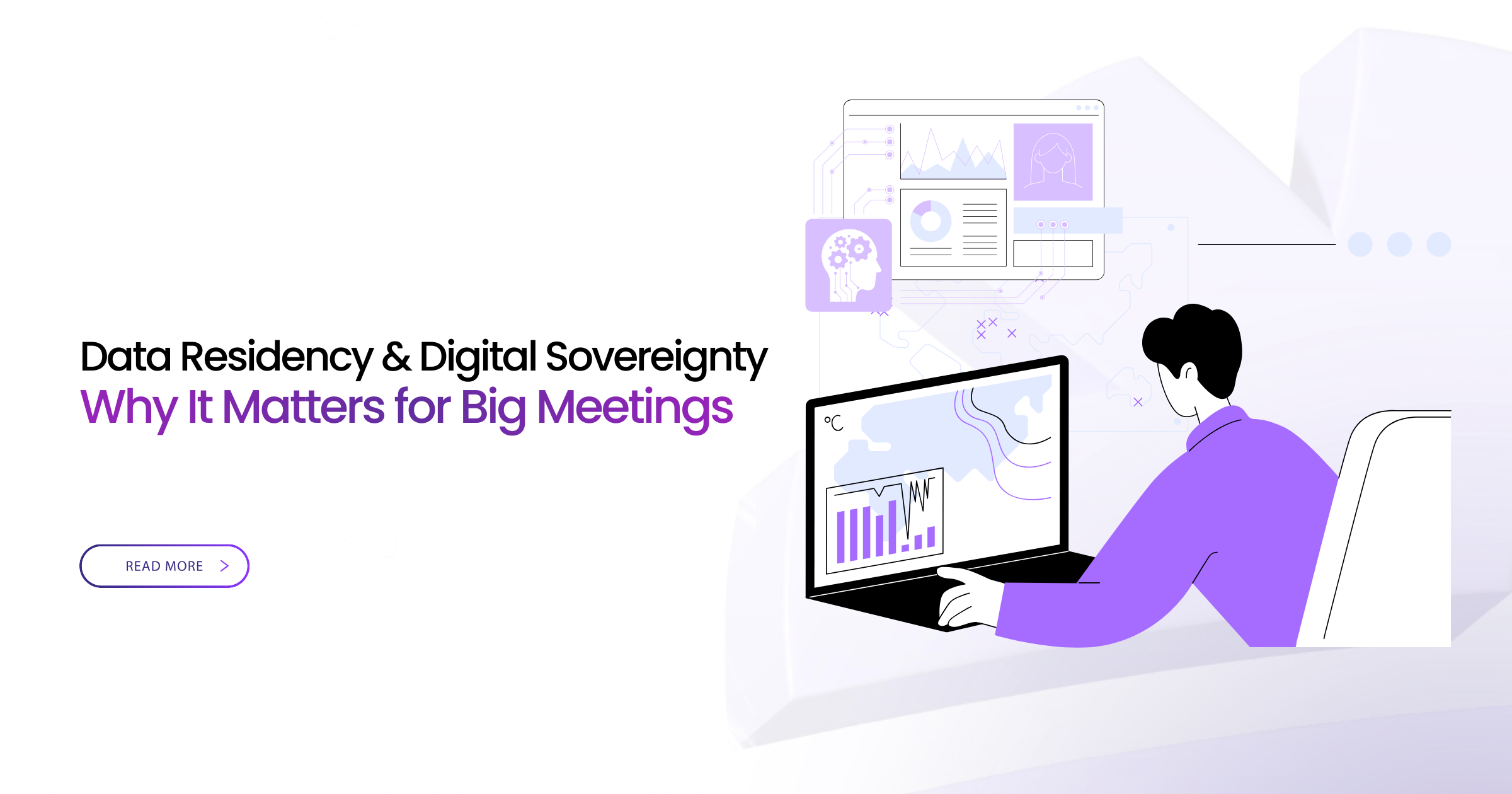
What Do “Data Residency” and “Digital Sovereignty” Really Mean?
Data Residency: The Basics (Compliance Lens)
Definition:
Data residency refers to physical and logical location where data is stored and processed, including:
Raw media:
- Video streams during live meeting
- Audio recordings
- Screen shares and presentations
- Participant video feeds
Derived artifacts:
- Post-meeting recordings
- AI-generated transcripts
- Translation outputs
- Meeting summaries and action items
- Extracted analytics and insights
Metadata:
- Participant IP addresses
- Device information
- Connection timestamps
- Geographic locations
- Usage patterns and behaviors
Why compliance officers care:
Jurisdiction determines:
Which regulators can inspect: Data stored in jurisdiction X falls under X’s data protection authority. That authority can demand access, conduct inspections, and enforce penalties for non-compliance.
Which laws apply: Privacy laws, data protection frameworks, sector-specific regulations—all determined by data location. Same data in different jurisdictions = different legal obligations.
Which subpoenas are enforceable: Courts in jurisdiction where data resides can compel production. Organizations may have no legal standing to resist foreign legal process even when content involves their citizens or operations.
Example:
Financial institution in Country A stores meeting recordings discussing market-sensitive information in cloud infrastructure located in Country B. Securities regulator in Country B investigating market manipulation can legally compel access to those recordings without Country A regulator involvement or consent. Institution may not even be notified until after access occurs.
Digital Sovereignty: The Broader Concept
Definition:
Digital sovereignty represents country’s or organization’s ability to control its digital infrastructure and data lifecycle independently, making autonomous decisions about:
- Where data resides
- How data is processed
- Who can access data
- Under which legal frameworks data exists
For governments and national institutions:
Data is strategic asset equivalent to physical territory. Government meetings discussing:
- National security matters
- Economic policy
- Legislative priorities
- Diplomatic negotiations
- Crisis response coordination
When hosted on foreign infrastructure, sovereignty is compromised. Foreign jurisdiction gains leverage—technical, legal, geopolitical—over national decision-making processes.
For enterprises and regulated entities:
Digital sovereignty involves:
Risk of foreign access: Foreign governments, intelligence services, or litigants potentially accessing strategic business information through legal processes in jurisdictions where data resides.
Long-term regulatory exposure: Compliance requirements evolve. Data stored today under acceptable framework might violate tomorrow’s regulations without ability to retroactively relocate historical records.
Negotiating power with vendors: Organizations lacking sovereign deployment options have limited leverage. Vendor controls data location, processing, and access regardless of customer preferences.
Why Data Residency Matters Specifically for Big Meetings
Theory Meets Reality
Small internal team meetings discussing routine operations create limited compliance exposure. Big meetings—3,000 to 10,000 participants—operate at different scale with different stakes:
Board Annual General Meetings:
- Market-sensitive disclosures
- Strategic direction announcements
- Shareholder voting records
- Executive compensation discussions
- Legal proceedings if disputes arise
Government Public Hearings:
- Citizen personal information (names, addresses, submissions)
- Policy positions and stakeholder feedback
- Constitutionally-mandated transparency requirements
- Freedom of information compliance
- Archives maintained for decades
Sector-Wide Regulator Calls:
- Confidential supervisory information
- Industry-wide compliance guidance
- Enforcement actions and investigations
- Financial stability discussions
- Crisis coordination protocols
National Training Programs:
- Employee or official personal data
- Proprietary methodologies and content
- Assessment results and certifications
- Attendance verification for regulatory requirements
Investor Briefings and M&A Updates:
- Material non-public information (MNPI)
- Deal structures and valuations
- Due diligence findings
- Integration plans
- Financial projections
Compliance Implications When Data Lives Abroad
Violation of data localization rules:
Many jurisdictions now mandate certain data categories remain within national boundaries:
- Government data (meetings involving public officials or policy)
- Financial sector data (banking, insurance, securities communications)
- Healthcare data (medical review boards, teleconsultations)
- Citizen personal information (public consultations, training programs)
Recording 5,000-person government hearing on foreign cloud infrastructure constitutes systematic violation if data localization applies.
Breach of sector-specific circulars:
Regulators often issue guidance beyond general data protection law:
- Central banks requiring bank board meetings stay within national financial system infrastructure
- Securities regulators mandating market-sensitive communications remain under their jurisdiction
- Healthcare authorities requiring patient data, including telehealth recordings, within national health data framework
Internal information classification policy violations:
Many organizations classify information:
- Public: No restrictions
- Internal: Employees only
- Confidential: Specific roles only
- Restricted: Extreme controls required
Confidential or restricted meeting recorded on vendor’s global cloud infrastructure violates classification control requirements. Information theoretically accessible to vendor staff, foreign legal process, or potential security breaches in any country where vendor operates.
Exposure to foreign discovery and subpoenas:
US CLOUD Act explicitly allows US law enforcement to compel US-based companies to produce data regardless of where stored globally. European jurisdictions have similar provisions. Data stored abroad creates exposure to foreign legal processes your organization cannot control or contest effectively.
Geopolitical and sanctions-related access risks:
During international tensions, governments have:
- Demanded technology companies provide access to foreign user data
- Blocked access to cloud services affecting specific regions
- Imposed sanctions preventing service to certain countries or entities
- Required backdoors or monitoring capabilities for data stored in their jurisdiction
Meeting platform hosted in geopolitically volatile jurisdiction creates operational and strategic risk.
Regulatory Drivers Behind Data Residency for Meetings
Cross-Border Data Transfer Risk
Default architecture of major platforms:
Zoom, Microsoft Teams, Webex, Google Meet—all architected for global deployment with data:
- Processed in nearest regional data center for performance
- Replicated across regions for redundancy and disaster recovery
- Aggregated centrally for analytics, AI model training, and service improvement
- Transmitted to headquarters jurisdiction for engineering access and support
Even when vendor offers “regional hosting,” data typically still flows cross-border for various operational purposes rarely transparent to customers.
Triggering compliance requirements:
Cross-border data transfer triggers:
Data Protection Impact Assessments (DPIA): Required under GDPR and equivalent frameworks when processing involves cross-border transfer of sensitive data. Large meeting recordings containing personal information = sensitive data requiring DPIA.
Standard Contractual Clauses (SCCs): Legal mechanism for legitimizing transfers from EU to third countries. Requires assessment of destination country’s legal framework. If inadequate protection, transfers prohibited despite SCCs.
Regulator pre-approval or notification: Some jurisdictions require explicit regulator approval before transferring certain data categories abroad. Financial sector, healthcare, government data often fall into requiring pre-approval category.
Sector-Specific Sensitivities
Financial Institutions:
Central banks and securities regulators increasingly expect:
Audit trail integrity: Complete records of all board meetings, risk committee sessions, and market-sensitive communications. Audit trails lose evidentiary value if stored under foreign jurisdiction subject to foreign legal modification or access.
Market abuse prevention: Recordings of trading floor communications, client advisory sessions, and investment committee decisions used to investigate market manipulation. Must remain under securities regulator jurisdiction for investigation purposes.
Stress test confidentiality: Bank supervisory discussions about stress test results, capital adequacy, and resolution planning are market-sensitive. Foreign jurisdiction access creates insider trading and market stability risks.
Healthcare:
Teleconsultation recordings: Contain protected health information subject to strict privacy requirements. Storage outside healthcare regulatory authority’s jurisdiction creates compliance exposure and patient privacy violations.
Medical review board sessions: Peer reviews, morbidity and mortality discussions, credentialing decisions—all highly sensitive requiring secure retention under healthcare regulator oversight.
Research ethics committee meetings: Discuss patient data, trial protocols, adverse events. Cross-border storage may violate research ethics frameworks and institutional review board requirements.
Government:
Cabinet and ministerial meetings: Discussions involving national security, policy formulation, legislative strategy. Foreign storage compromises constitutional separation of powers if foreign authorities can access.
Parliamentary committee proceedings: Some confidential despite eventual public disclosure. Storage abroad during confidential period violates parliamentary privilege and constitutional requirements.
Inter-agency coordination: Defense, intelligence, law enforcement coordination meetings contain information requiring highest classification. Foreign cloud storage constitutes security breach.
Upcoming and Evolving Sovereignty Rules
National trend toward data localization:
Dozens of countries implementing or strengthening requirements:
- “Critical data must be stored in-country”
- “Government data prohibited on foreign platforms”
- “Financial sector data must use national cloud providers”
- “Healthcare data requires domestic infrastructure”
Mandatory national cloud usage:
Governments establishing national cloud frameworks with requirements:
- Public sector must use government cloud for sensitive systems
- Regulated industries must use nationally-licensed cloud providers
- Data sovereignty verified through regular audits
- Foreign cloud providers must establish local subsidiaries with local data residency guarantees
Explicit restrictions on foreign tools:
Some governments banning or restricting foreign collaboration tools for official use:
- Procurement prohibited for government agencies
- Sector regulators issuing circulars against specific platforms
- National security reviews blocking certain vendors
- Data protection authorities restricting specific services
Compliance officers cannot assume current regulatory environment remains stable. Proactive data residency planning prevents future compliance crises.
What Actually Happens to Data in Foreign-Hosted Meeting Platform
Realistic Data Flows
Media stream processing:
Participant in Country A joins meeting:
- Video/audio stream uploads to nearest data center (Country B)
- Platform transcodes stream for different quality levels (Country B)
- AI speech-to-text processes audio (often Country C—US or EU AI clusters)
- Streams distribute to other participants via content delivery network (multiple countries)
- Recording saves to regional storage (Country D determined by vendor optimization)
Single meeting potentially touches infrastructure in 5-10 countries.
Logs and telemetry:
Diagnostic data—connection logs, device info, performance metrics, error reports—typically flow to:
- Central engineering monitoring systems (vendor headquarters)
- Regional analytics platforms (major cloud regions)
- Support ticket systems (wherever support teams operate)
- Security operations centers (vendor security team location)
AI transcription and processing:
Most platforms send audio to centralized AI infrastructure:
- US-based AI clusters for English transcription
- EU-based clusters for European languages
- Specialized regional clusters for other languages
- Audio temporarily stored during processing
- Transcripts permanently stored in same infrastructure as recordings
Support snapshots and debugging:
When technical issues occur:
- Platform captures diagnostic snapshot
- Snapshot may include meeting metadata, participant info, partial content
- Transmitted to engineering team location for analysis
- Retained in support systems indefinitely for future reference
Metadata and Control
Even with encryption, jurisdiction matters:
Encryption protects confidentiality during transmission and storage. It does not address:
- Who controls encryption keys (vendor or customer)
- Which jurisdiction’s courts can compel key disclosure
- Which country’s laws govern data retention and deletion
- Which authorities can demand access without customer knowledge
Vendor terms often permit extensive data use:
Standard terms of service typically include:
- “We may process your data to improve our services”
- “We use aggregate anonymized data for analytics”
- “We may use customer data to train AI models”
- “We share data with affiliates and service providers globally”
“Minimal data” and “aggregated” arguments fail under regulatory scrutiny when:
- Meeting content includes regulated personal information
- Platform reuses government hearing recordings for AI training
- Vendor analytics derive insights about organizational structure, decision-making, or sensitive operations
- Sub-processor chains unclear—vendor uses dozens of service providers with own data practices
Risk Categories for Compliance Teams
Legal and Regulatory Risk
Breach of data localization requirements:
Direct violation of data protection law or sector regulation requiring data remain in-country. Potential penalties:
- Regulatory fines (percentage of revenue or fixed amounts)
- Orders to cease processing and delete data
- Mandatory audits and remediation
- Public disclosure of violations
Inability to respond to regulator queries:
Data protection authority asks: “Where exactly is the recording of your May 15 stakeholder consultation stored?”
Compliance officer contacts vendor. Vendor response: “Data stored in our global infrastructure optimized for performance and redundancy. Specific locations vary dynamically.”
Unsatisfactory response creates:
- Presumption of non-compliance
- Additional regulator scrutiny
- Reputational damage with oversight authorities
- Potential escalation to enforcement action
Data subject rights complications:
GDPR and equivalent frameworks grant individuals:
- Right to know where personal data stored
- Right to data portability (complete copy in usable format)
- Right to deletion (complete erasure)
When meeting platform stores data across multiple foreign jurisdictions with unclear sub-processors:
- Cannot accurately inform individuals where data resides
- Cannot guarantee complete deletion (backups, replicas, archives)
- Cannot verify data portability includes all copies
Each constitutes potential violation of data subject rights.
Contractual and Fiduciary Risk
Client contract violations:
Financial institution promises clients: “Your data remains within [country] under [country] jurisdiction.”
Then uses meeting platform storing board discussions about client portfolios on foreign servers. Contract breach. Potential client lawsuits, relationship damage, mandate losses.
Shareholder expectations:
Publicly-traded company has data protection and sovereignty commitments in corporate governance policies. Shareholders expect board to ensure compliance.
AGM recorded on foreign platform violates those commitments. Shareholder derivative suits potential. Director liability exposure. Institutional investor governance concerns.
Regulatory relationship damage:
Regulated entities maintain relationship with oversight authorities based on trust and compliance credibility. Discovering entity uses non-compliant meeting platform for regulatory interactions damages that relationship.
Regulator questions whether organization takes compliance seriously. Increased scrutiny across all operations, not just meeting platforms.
Operational and Continuity Risk
Dependence on foreign infrastructure:
Critical government meeting scheduled during international crisis. Cloud provider experiences:
- Regional outage due to geopolitical tension
- Service degradation from sanctions-related restrictions
- Access blocked due to cross-border disputes
- Performance issues from international backbone disruptions
Government cannot conduct critical coordination because dependent on foreign infrastructure potentially affected by factors beyond national control.
Data access during disputes:
Contractual dispute with vendor. Organization withholds payment due to service issues. Vendor threatens to suspend service or withhold data access.
Meeting archives—years of recordings required for regulatory compliance—held hostage in vendor systems under foreign jurisdiction. Limited legal recourse. Potential compliance violations from inability to access own data.
Sanctions and export control complications:
Organization operates internationally including some sanctioned regions for humanitarian, diplomatic, or commercial reasons. Meeting platform headquartered in jurisdiction with extensive sanctions regimes.
Vendor discovers sanctioned entity participants in past meetings. Potential service termination, data freeze, or mandatory disclosure to sanctions authorities. Creates operational crisis and potential sanctions violations despite organization’s legitimate purposes.
Reputational Risk
Media headline scenarios:
Scenario 1: “Central Bank Used Foreign Platform for Crisis Coordination—Recordings Stored in [Geopolitical Rival]”
Scenario 2: “Government Public Hearing Data Processed Abroad Despite Data Protection Law”
Scenario 3: “Regulator Enforcement Discussions Recorded on Platform Subject to Foreign Subpoenas”
Scenario 4: “Healthcare Board Meeting Recordings Accessible Through [Foreign Country] Legal Process”
Each creates:
- Public trust erosion
- Parliamentary or legislative inquiry
- Opposition party criticism
- Activist shareholder resolutions
- Media scrutiny of broader governance practices
Reputational damage often exceeds direct compliance penalties.
How Digital Sovereignty Changes the Big Meetings Strategy
Sovereign Infrastructure for Critical Meetings
Deployment options ensuring data residency:
National cloud providers: Licensed operators within national jurisdiction meeting regulatory requirements for data residency, sovereignty, and compliance.
Government data centers: Public sector cloud infrastructure specifically for government use. Meets highest sovereignty and security requirements.
On-premise deployment: Platform runs on organization’s own infrastructure. Complete control over data location, access, and lifecycle.
Certified local providers: Private sector providers certified by regulators for handling sensitive data. Subject to national oversight and audit.
Essential requirements:
Recordings and transcripts stay in-country: All artifacts from meeting—video, audio, transcripts, chat logs, files—stored exclusively within national boundaries.
AI processing locally: Speech-to-text, translation, summarization occurs on domestic infrastructure. Audio never transmitted abroad for processing.
Logs under sovereign control: Complete audit trails, access logs, diagnostic data retained domestically subject to national legal process only.
Encryption keys customer-controlled: Organization, not vendor, controls encryption keys. Vendor cannot access content even with physical server access.
Policy-Based Meeting Classification
Not all meetings carry equal risk:
Compliance officers should drive meeting classification policy:
Tier 1: Critical/Official (Sovereign mandatory)
- Government cabinet and ministerial meetings
- Board meetings with market-sensitive information
- Regulatory authority proceedings
- Public hearings with citizen data
- Crisis coordination and emergency response
- National security or defense discussions
Requirements: Sovereign infrastructure, on-premise preferred, complete data residency, customer-controlled encryption, no foreign sub-processors.
Tier 2: Internal/Sensitive (Sovereign recommended)
- Department-level operational meetings
- HR performance and compensation discussions
- Procurement committee deliberations
- Internal compliance and audit meetings
- Risk committee sessions
- Strategic planning workshops
Requirements: National cloud minimum, clear data residency documentation, stringent vendor contractual controls.
Tier 3: External/Low-Sensitivity (Flexible)
- Marketing webinars open to public
- Product demonstrations
- Industry conference participation
- Recruiting information sessions
- Public relations events
Requirements: Standard commercial platforms acceptable with appropriate data processing agreements.
Policy enforcement:
Technology controls prevent wrong platform use:
- Calendar integration checks meeting sensitivity classification
- Blocks creation of Tier 1 meetings on non-sovereign platforms
- Requires approval workflow for Tier 2 on commercial platforms
- Provides guidance on appropriate platform selection
Questions Compliance Officers Should Ask Vendors
1. Data Location and Architecture
Where exactly are recordings, transcripts, and logs stored?
- Specific countries and data center locations
- Whether storage location varies by customer or global
- How organization can verify storage location continuously
Are they ever replicated outside my country or region?
- Backup and disaster recovery practices
- Data redundancy across regions
- Temporary processing in other locations
- Analytics or monitoring that requires data movement
Can we select specific data residency?
- Options for single-country storage
- Whether residency selection binding
- Additional costs for residency controls
- Audit rights to verify compliance
2. Jurisdiction and Legal Control
Which country’s law governs your hosting infrastructure and company operations?
- Vendor corporate headquarters jurisdiction
- Infrastructure provider jurisdiction (if using third-party cloud)
- Data processing locations and applicable laws
- Relevant data protection frameworks
Can foreign authorities request access to our meeting data?
- Which jurisdictions can issue enforceable legal process
- Vendor policies on responding to government data requests
- Whether customers notified before disclosure (if legally permissible)
- Historical transparency on government requests
What happens if there’s conflict between our country’s laws and yours?
- How vendor handles conflicting legal obligations
- Whether customer can prohibit cross-border disclosure
- Contractual commitments regarding jurisdiction
3. Sub-Processors and AI
Which third parties process any part of our media or metadata?
- Complete list of sub-processors
- What each processes (video, audio, transcripts, logs)
- Where each operates geographically
- How often list updated
Is any meeting data used to train AI models?
- Whether customer data contributes to model training
- Opt-out options
- Whether training occurs on aggregated/anonymized data
- How aggregation and anonymization verified
Where does AI processing occur?
- Geographic location of AI inference infrastructure
- Whether audio/video transmitted abroad for processing
- Data retention during AI processing
- Whether AI processing uses customer infrastructure or vendor systems
4. Deployment Options
Do you offer national cloud, on-premise, or sovereign hosting?
- Available deployment models
- Whether functionality identical across deployments
- Implementation timeline and complexity
- Ongoing support and update processes
Can all data be fully contained within our infrastructure?
- Which features require external connectivity
- Whether complete air-gapped deployment possible
- How updates and support handled in isolated deployment
- Performance implications of sovereign deployment
5. Exit and Portability
Can we export and fully delete meeting archives on demand?
- Export formats and completeness
- Whether includes all metadata and logs
- Deletion verification process
- Timeline for complete deletion
What happens to backups and logs when we terminate?
- Backup retention policies
- Whether backups subject to same deletion requests
- Third-party backup systems
- Verification of complete data destruction
Why Sovereign Meeting Platforms Emerging as New Category
Architectural Priorities Differ
Generic global meeting tools optimize for:
Global scale: Single infrastructure serving customers worldwide. Economies of scale through centralization.
Performance efficiency: Route traffic through nearest data center regardless of customer location or sovereignty requirements.
Cost optimization: Shared infrastructure, multi-tenancy, centralized AI processing reduce per-customer costs.
Feature velocity: Rapid feature deployment across global infrastructure. Sovereignty controls slow development.
These priorities make sense for multinational corporations with distributed teams requiring global connectivity.
Sovereign meeting platforms prioritize:
In-country hosting: Data remains within national boundaries by architecture, not policy or configuration.
Compliance-aligned data flows: Every data movement designed to satisfy regulatory requirements. No silent cross-border processing.
Local AI and edge routing: Speech-to-text, translation, analytics occur on domestic infrastructure. Performance optimization through regional deployment, not international traffic.
Auditability and governance: Complete transparency into data location, processing, and access. Designed for regulatory inspection and compliance verification.
These priorities essential for governments, regulated industries, and organizations with sovereignty requirements.
Big Meetings Create Regulated Digital Records
Small meetings—team standups, project check-ins, client calls—generate limited compliance exposure. Content typically ephemeral. Participants limited. Sensitivity moderate.
Large meetings—5,000 to 10,000 participants—fundamentally different:
Scale creates regulated records: Formal proceedings recorded for transparency, accountability, legal requirements. Archives maintained for years or decades.
Participants bring compliance obligations: Public hearings include citizens whose personal information triggers privacy law. Regulator calls include supervised entities whose discussions trigger sector regulations. Board meetings include shareholders whose interests create fiduciary duties.
Stakes justify scrutiny: Government, regulators, media, civil society examine how these meetings conducted. Compliance failures become public controversies, not internal issues.
When 5,000-10,000 people join hearing, training, or AGM, you’re not just running event—you’re creating regulated digital record. Sovereign control over that record has become compliance requirement, not luxury.
Example Scenarios Where Data Residency Is Non-Negotiable
Central Bank Crisis Coordination
Scenario: Central bank convenes emergency meeting with commercial bank CEOs during financial stability crisis. Discussion covers:
- Specific bank vulnerabilities
- Systemic risk assessment
- Potential intervention measures
- Liquidity provision strategies
Why residency critical:
Information is market-sensitive. Foreign access through legal process or security breach could trigger:
- Bank runs based on leaked vulnerability information
- Market manipulation using advance knowledge of interventions
- Regulatory arbitrage as institutions position ahead of measures
- International speculation affecting currency and sovereign debt
Recording must stay under central bank’s exclusive control within national financial stability framework.
National E-Governance Review
Scenario: Government conducts review of national digital ID system. Meeting involves:
- Discussion of citizen database structure
- Security vulnerabilities and remediation
- Integration with government services
- Vendor performance and contract renewal
Why residency critical:
Meeting contains:
- Technical details about national critical infrastructure
- Security information adversaries could exploit
- Citizen data privacy implications
- Sovereign digital infrastructure strategy
Foreign storage violates principles of digital sovereignty and creates national security risk.
Regulator Public Hearing
Scenario: Financial services regulator hosts public consultation on proposed regulations. Stakeholders include:
- Banks and financial institutions
- Consumer advocates
- Industry associations
- Individual citizens
Why residency critical:
Legally-mandated proceeding. Recordings constitute official regulatory record. Participants include citizens exercising democratic rights. Storage abroad:
- Violates administrative law requirements for record integrity
- Compromises citizen privacy and data protection rights
- Subjects regulatory process to potential foreign interference
- Creates constitutional concerns about regulatory independence
State-Owned Enterprise AGM
Scenario: SOE holds annual general meeting with shareholders including government, institutional investors, public shareholders. Discusses:
- Financial performance including market-sensitive results
- Strategic direction and major investments
- Board elections and governance matters
- Related party transactions
Why residency critical:
SOE subject to securities regulations requiring careful handling of material non-public information. AGM recording contains MNPI that could:
- Leak ahead of official disclosure creating insider trading liability
- Become subject to foreign legal discovery in shareholder disputes
- Fall under foreign jurisdiction inconsistent with securities law requirements
Must remain under securities regulator oversight within national capital markets framework.
Cross-Ministerial National Security Task Force
Scenario: Multiple ministries coordinate on national security matter—counterterrorism, cyber defense, border security, intelligence integration.
Why residency critical:
Discussions classified or official secrets. Participants include intelligence and security officials. Content directly impacts national security. Foreign storage:
- Constitutes security breach regardless of encryption
- Violates official secrets and classification requirements
- Creates espionage risk through foreign access
- Compromises operational security and source protection
Requires highest level sovereign deployment—on-premise, air-gapped, government-controlled infrastructure.
Common thread across all scenarios:
“If the recording, transcript or logs of this meeting sit in foreign cloud, we have sovereignty and compliance problem.”
Final Takeaway: For Compliance, “Where” Is as Important as “What”
Security Does Not Equal Sovereignty
You can implement:
- Strong encryption (AES-256)
- Multi-factor authentication
- Role-based access controls
- Audit logging
- Security monitoring
But if your big meetings live on foreign clouds under foreign laws, you still don’t fully control the risk.
Encryption protects confidentiality. It doesn’t address:
- Jurisdiction and legal authority
- Data residency and cross-border transfers
- Sovereign control and independence
- Regulatory compliance and audit rights
- Operational resilience and continuity
Compliance Requires Architectural Control
Compliance officers cannot achieve data residency through:
- Vendor promises and contractual terms
- Configuration settings and regional preferences
- Privacy policies and data processing agreements
Compliance requires:
- Infrastructure under your jurisdiction
- Data physically within your boundaries
- Processing exclusively in your control
- Legal framework of your choosing
Architecture determines compliance outcomes, not contracts.
Action Items for Compliance Officers
Push for sovereign deployment for critical meetings:
Advocate internally for investment in:
- On-premise or national cloud meeting infrastructure
- Compliance-first platform selection criteria
- Sovereign deployment for Tier 1 meetings
- Migration plan for existing non-compliant meetings
Formalize meeting classification and residency requirements:
Develop organizational policy:
- Meeting sensitivity tiers with deployment requirements
- Data residency rules mapped to data classification
- Approval workflows preventing wrong platform use
- Regular compliance audits of meeting platform usage
Involve stakeholders in collaboration standards revision:
Coordinate across:
- Security: Technical controls and architecture
- IT Operations: Deployment and support models
- Legal: Jurisdictional risk and contractual protections
- Business units: Use case requirements and usability
- Executive leadership: Budget and strategic priorities
Data residency for big meetings is cross-functional compliance imperative, not IT technical detail.
The Compliance Reality
Organizations discovering their 5,000-person public hearings, board AGMs, regulatory proceedings recorded on foreign clouds face uncomfortable questions:
- How long has this non-compliance existed?
- What exposure accumulated?
- How quickly can we remediate?
- What do we report to regulators?
Proactive data residency planning prevents these crises. Sovereign meeting infrastructure ensures big meetings generate compliant digital records from day one.
Because in 2025 and beyond, compliance officers will be judged not just on what data they protect, but where that data lives and who controls it.
Detailed FAQs: Data Residency & Digital Sovereignty for Big Meetings
Data residency refers to the geographical location where your meeting data is stored, processed, and backed up. This includes recordings, AI transcripts, chat logs, attendance lists, user profiles, audit logs, and diagnostic metadata. In regulated sectors such as government, finance, education, and healthcare, laws or policies may require that all of this data stays inside the country or within a legally approved region. The moment your meeting data crosses borders, it may fall under different privacy laws, be exposed to foreign government access requests, or lose evidentiary protection.
Data residency answers the question where does the data live, while digital sovereignty answers who has ultimate control over that data and the digital infrastructure around it. Digital sovereignty means that foreign governments cannot compel access, cloud providers cannot unilaterally move data, AI pipelines are governed in-country, and encryption keys remain under national or organizational ownership. A platform may offer local storage, but still lack sovereignty if its infrastructure, AI components, or cryptographic keys are controlled from outside the country.
Large-scale meetings such as public hearings, board AGMs, tender evaluations, procurement committees, disciplinary hearings, and policy consultations generate high-risk, regulated content. If these records are stored outside national borders, organizations may face compliance violations, increased legal discovery risk, and loss of control over sensitive citizen or organizational data. Regulators increasingly expect organizations to show not only that their data is secure, but also where it resides and which jurisdiction governs it.
The most sensitive categories typically include video and audio recordings of official meetings, AI-generated transcripts, decision-making conversations, votes, polls and Q&A, attendance and identity logs, chat discussions containing confidential information, screen shares of internal documents, and metadata such as IP addresses and device identifiers. This data often combines personal information, commercially sensitive details, and policy-level decisions, so it must be governed with strict residency, access-control, and retention rules.
Storing meeting data on foreign clouds or multi-region SaaS platforms can trigger violations of national data-localization laws, expose information to foreign surveillance or discovery regimes, and complicate consent and impact assessments under frameworks like GDPR or national privacy acts. It can also weaken the chain-of-custody for digital evidence. In many jurisdictions, cross-border storage of official meeting records is treated as a high-risk configuration that requires strong justification and compensating controls.
Not by default. Most global platforms are designed around multi-region cloud routing, use centralized AI engines, and rely on foreign sub-processors for logging, analytics, or content delivery. Even when they offer options to store recordings in a chosen region, other data such as diagnostics, logs, or AI workloads may still leave the country. For governments and highly regulated industries, this can fall short of emerging residency and sovereignty expectations, which is why many are now looking at sovereign or in-country hosted meeting solutions.
The strictest requirements are typically found in government agencies, defense and intelligence bodies, law enforcement, courts and the judiciary, banks and financial institutions, telecom operators, healthcare providers, energy and critical infrastructure operators, and education regulators. For these sectors, meeting data often qualifies as official record or regulated information and must be hosted in-country with clear auditability and jurisdictional control.
Organizations should perform a structured audit that covers where each type of meeting data is stored, whether recordings or transcripts are processed or backed up outside the country, whether global CDNs or sub-processors are used, which laws apply to stored data, and whether the platform can technically enforce single-country hosting. They should also review data-processing agreements, impact assessments, and logs to see if any cross-border transfers are happening in practice, not just in theory.
Depending on the jurisdiction, non-compliance can lead to regulatory investigations, monetary penalties, suspension of licenses or approvals, restrictions on future procurement, legal liability in case of incidents, loss of evidentiary admissibility, and serious reputational damage. For public-sector entities, the impact is even higher because meeting records may contain citizen data or sensitive national matters, and failures can quickly become public issues.
Sovereign meeting platforms are engineered to keep the entire meeting pipeline — ingestion, storage, AI processing, logs, and analytics — under in-country or organization-controlled infrastructure. They typically offer in-country hosting, local AI transcription, local encryption key ownership, deployment on national or government clouds, full audit logs, and no foreign sub-processors. This design makes it much easier for compliance teams to prove that sensitive meeting records never leave approved jurisdictions.
Key questions include where each category of data is stored, whether recordings and transcripts are processed abroad, which sub-processors are involved, what laws apply to stored data, whether sovereign or national cloud deployment is supported, how encryption keys are managed, how long logs are retained, whether cross-border transfers can be technically blocked, and what documentation is available to support DPIAs and regulatory audits.
Convay is designed as a sovereign, compliance-first meeting platform. It supports in-country or on-premise hosting, sovereign AI engines for transcription, encryption keys that remain under customer or national control, deployment on national clouds or government clouds, comprehensive audit logs, and clear documentation mapped to common regulatory frameworks. This helps governments and enterprises ensure that big meetings generate compliant, sovereign, and audit-ready digital records from day one.
In many cases, yes. AI-generated transcripts convert everything that was said into searchable, analyzable text, which is easier to mine, copy, and export than raw media files. Transcripts often contain sensitive details, are retained longer, and may pass through external AI services if the platform is not sovereign. This makes the location and control of transcription pipelines a critical focus area for regulators and security teams.
Global trends strongly suggest that enforcement will increase. More countries are introducing localization rules, tightening cross-border transfers, promoting sovereign or national clouds for public-sector workloads, and expecting DPIAs in technology procurement. For high-stakes meetings, regulators are starting to treat questions such as where the data resides, who can access it, and under which jurisdiction it falls as standard due-diligence items rather than optional extras.